
10 Most Effective Japanese Flashcard Apps for JLPT
As someone who’s learned Japanese for 10 years, I can emphasize that learning kanji and vocabulary is a long process that requires tons of exposure and practice. This is where flashcard apps come in handy. Flashcard apps are one of the most practical tools for retaining large amounts of Japanese vocabulary and kanji without overloading your brain. But choosing the right app for your learning style is crucial, since the wrong one can waste precious time in your language-learning journey.
Whether your goal is to expand your vocabulary, study for the JLPT, or simply build your vocabulary, many flashcard apps can make studying Japanese much easier. We have heard from many students and teachers about various apps that work with them. This guide covers everything you need to know about flashcard apps, plus the best apps for learning Japanese.
What Makes a Good Japanese Flashcard App
The best Japanese flashcard apps help learners remember vocabulary and kanji through spaced repetition, native audio, and structured review lessons. Japanese has tens of thousands of words and 2,136 kanji characters used in everyday life, which can feel overwhelming for most learners. However, these modern-day tools make learning Japanese much easier today, as long as you use them consistently.
They Use Spaced Repetition (SRS)

Spaced repetition (SRS) is a method that lets learners review information at increasing intervals. Spaced repetition helps learners retain information over time by prioritizing cards they tend to forget more than cards they seem to know. Many flashcard apps use this spaced repetition system by making sure cards the learner tends to forget pop up more, thus increasing the likelihood of retaining a given vocabulary word or kanji.
Remember, spaced repetition works best when you use it consistently, which increases how well you know the information over time. Not doing so can reduce your likelihood of fully retaining what you learned, which can slow your Japanese learning journey.
Native Audio & Pronunciation
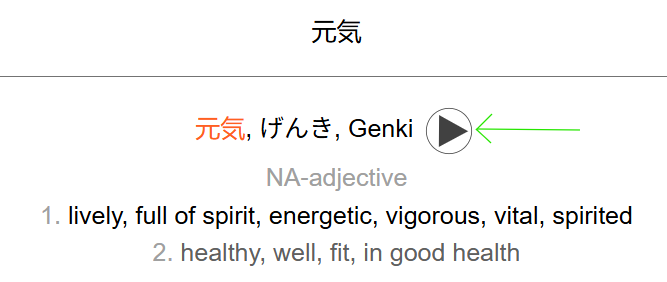
Japanese flashcards that include audio, ideally spoken by a native speaker, can also help learners connect written vocabulary to spoken Japanese. Flashcard apps that let you hear how a word is pronounced in Japanese are good practice for recognizing words in conversation.
Kanji & Stroke Order Support
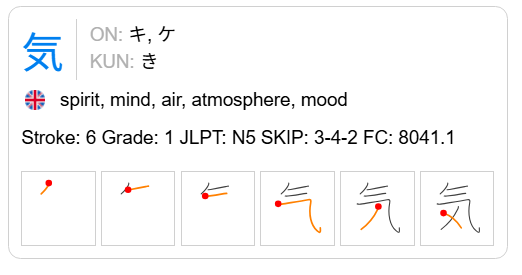
If you’re focusing on kanji, the best Japanese kanji flashcards include stroke-order diagrams, readings for each character, and examples in word form. These features are especially useful for learners who want to not only know kanji, but also recognize, write, and understand them in context.
JLPT-level Vocabulary Decks
If you’re preparing for the JLPT, choosing an app with vocabulary and kanji decks organized by level (N5 through N1) can be particularly helpful, as level-based decks help you focus on relevant study material. However, they shouldn’t replace other JLPT preparation resources.
Offline Access
Offline access lets you review Japanese vocabulary when you don’t have an internet connection. This includes traveling by plane or being in an area with no internet connection.
Pricing
While many flashcard apps are free, some require a payment plan. Compare free and premium plans, particularly their limits on flashcards, audio, deck customization, and more review features.
Japanese Flashcard Apps: Quick Comparison
The best Japanese flashcard app depends on your learning goals. Are you aiming to memorize everyday vocabulary? Do you feel like your kanji knowledge is weak? Or maybe you’re already fluent and trying to prepare for the JLPT.
The table below compares 10 Japanese learning apps based on different factors such as their ideal users, pricing models, JLPT study support, and spaced repetition (SRS) features:
| App | Best for | Free or paid | JLPT decks | SRS |
|---|---|---|---|---|
| Anki | Custom vocabulary decks | Free / Paid on iOS | Community decks | Yes |
| WaniKani | Kanji and vocabulary | Free trial levels / Paid | JLPT-relevant content | Yes |
| Renshuu | All-around Japanese study | Free / Premium | Yes | Yes |
| Quizlet | Simple vocabulary flashcards | Free / Premium | Community-created JLPT decks | Limited / mode-dependent |
| Bunpro | JLPT grammar and vocabulary | Trial / Paid | Yes | Yes |
| Mochi Cards | Custom flashcards and note-taking | Free / Pro | Yes, import or create JLPT decks | Yes |
| Mochi Cards | Simple SRS flashcards | Free / Premium | Import or create decks | Yes |
| jpdb | Vocabulary from anime and Japanese media | Free / Optional supporter tier | JLPT-relevant vocabulary; media-focused decks | Yes |
| Okiru | Daily study habits and motivation | Pro / Premium | Yes | Yes |
| Kitsun | Japanese vocabulary decks | Paid / trial availability varies | Found in community decks | Yes |
| J-Standard | Structured Japanese lessons | Verify current plan | Yes, designed specifically for JLPT preparation | Yes |
Editorial note: This is a working comparison. It’s best to confirm current plan availability, JLPT deck support, and SRS functionality on each product’s official site before publishing. J-Standard is Coto’s own learning platform and is included as a complementary option rather than a conventional SRS flashcard app.
The 10 Best Flashcards to Learn Japanese
1. J-Standard: Best for Structured JLPT Preparation
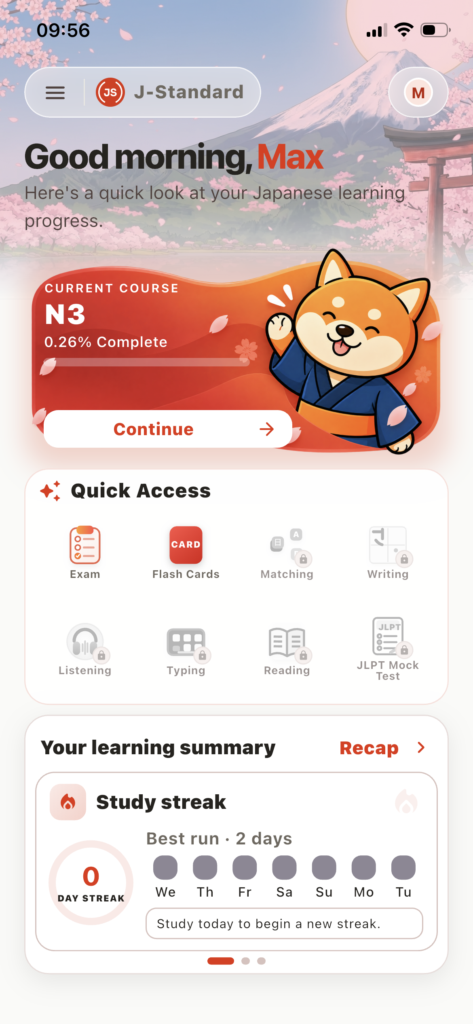
Pros of J-Standard:
- Structured lessons organized by JLPT level
- Covers JLPT material on vocabulary, kanji, grammar, reading, and listening
- Video explanations from Japanese instructors experienced in helping students with the JLPT
- Example sentences with native audio
- Practice quizzes and mock JLPT exams
- Learning dashboard for progress tracking
- Self-paced lessons accessible on m multiple devices
- Developed by Coto Japanese Academy
Cons of J-Standard
- Not a dedicated flashcard app
- Less suitable for learners who only want customizable vocabulary cards
- Requires a paid subscription
- Primarily focuses on JLPT preparation if that’s not your goal
J-Standard Pricing
| Plan | Price(JPY) | Features |
| Trial | Free Registration | Opportunity to try the platform before subscribing |
| Monthly | ¥1,500/month | Access to JLPT N5–N2 learning content and progress dashboard |
| Annual | ¥15,000/year | Same learning content and dashboard access at a discounted annual rate |
Note: Prices are based on J-Standard’s Japanese website and include tax. Course availability and pricing may differ between regional or English-language offerings.
J-Standard is an online Japanese learning platform developed by Coto Japanese Academy, designed to help learners prepare for the Japanese-Language Proficiency Test (JLPT). Unlike flashcard apps like Anki and Mochi Cards, J-Standard is one of the most structured Japanese learning apps, covering JLPT levels N5 to N2, including language knowledge, vocabulary, grammar, reading, and listening.
While J-Standard isn’t necessarily a flashcard app, it includes spaced repetition tools within its structured lessons that users can use to practice for the JLPT.
Why Choose J-Standard to Study Japanese?
What makes J-Standard stand out is its structured JLPT preparation curriculum, combining both lessons and flashcards into one system. Rather than simply memorizing vocabulary through flashcards, learners can follow lessons organized around the skills needed to pass their target JLPT level.
J-Standard also includes video explanations from Japanese instructors at Coto Academy, who are trained to teach students how to prepare for the JLPT. Students can also track their progress with J-Standard’s learning dashboard, which helps them identify what they’re struggling with and what they need to work on before the exam.
J-Standard also offers a B2B solution for companies with foreign workers who want to improve their employees’ Japanese language proficiency. Businesses can use its structured JLPT preparation courses and monitor their employees’ progress through a dedicated administrator dashboard.
Who Should Use J-Standard?

J-Standard is ideal for Japanese learners preparing for the JLPT who prefer a structured study plan designed to help them pass, rather than creating their own learning materials.
2. Anki: Best for Custom Flashcards

Pros of Anki:
- Fully customizable flashcards with audio and image features
- Very simple and user-friendly interface
- Powerful spaced repetition for long-term retention
- Community-created downloadable Japanese and JLPT vocabulary decks
Cons of Anki:
- Steeper learning curve for beginners
- Shared decks may vary in quality and accuracy
- Doesn’t provide structured Japanese lessons
- Creating your own decks can be time-consuming
Anki Pricing by Platform:
| Platform | Price | Version |
| Windows | Free | Anki Desktop |
| macOS | Free | Anki Desktop |
| Linux | Free | Anki Desktop |
| Android | Free | AnkiDroid |
| iOS (iPhone/iPad) | $24.99 | AnkiMobile |
| Web Browser | Free | AnkiWeb |
Note: AnkiMobile pricing may vary by country or region. There are no mandatory subscriptions for Anki’s core features.
Anki is one of the most well-known Japanese flashcard apps in the Japanese learning community, and often one of the best for learners who want to customize their vocabulary and kanji study. Anki uses a spaced repetition system (SRS) and can schedule reviews based on how well you remember each word, helping you retain Japanese vocabulary and kanji over time as you consistently review your cards.
Why Choose Anki?
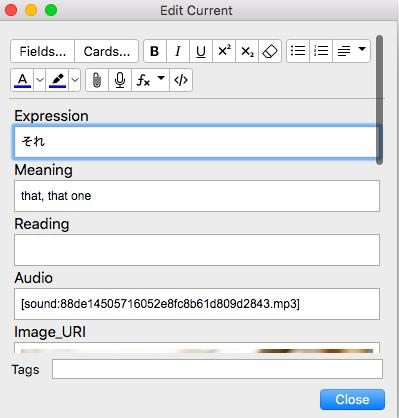
Anki stands out because you can add almost anything to your decks. Anki lets you create personalized flashcards with features such as words, definitions, readings, English translations, audio, images, and example sentences. Adding customizations to your decks can help reinforce your learning.
You can also download community-created decks from other learners, so you can learn from the same decks others have created and potentially achieve similar results. You can also share your own decks if you want to share your learning material with others. Some popular examples include the JLPT levels N5 through N5 deck and the Core 2K Japanese Deck.
Anki is especially useful if you are an intermediate or advanced Japanese learner trying to memorize vocabulary from anime, conversations, or even while studying for JLPT N2 to N1.
Who Should Use Anki?
The ideal users of Anki are generally JLPT learners and students who want complete control in reviewing their Japanese learning material.
2. WaniKani: Best for learning kanji
Pros of WaniKani:
- Covers necessary details about kanji such as radicals, definitions, and vocabulary
- Structured learning system
- Mnemonics to help remember kanji meanings and readings
- Spaced repetition for long-term memorization
- Over 2,000 kanji and 6,000 vocabulary words
- No need to create your own flashcard decks
Cons of WaniKani:
- Limited flexibility compared to Anki’s customizable decks
- Doesn’t teach Japanese grammar or conversation skills
- Doesn’t focus on kanji handwriting or stroke-order practice
- Learners must follow WaniKani’s progression rather than skipping ahead
- Decks do not contain organized JLPT levels
WaniKani Pricing:
| Plan | Price | Features |
| Free | $0 | Access to the first three levels |
| Monthly | Paid subscription | Access to all 60 levels |
| Annual | Paid subscription | Access to all 60 levels |
| Lifetime | One-time purchase | Permanent access to all 60 levels |
Note: Check WaniKani’s official pricing page for current subscription rates and available discounts.
WaniKani is one of the best Japanese kanji flashcard apps, especially if you are a beginner or intermediate learner of Japanese and want a more structured way to memorize kanji. Just like Anki, WaniKani uses a spaced repetition (SRS) system to help learners remember Japanese kanji over time. However, unlike Anki, WaniKani does not have functions that allow you to customize your deck; rather, it provides a more structured learning system that teaches you over 2,000 kanji and 6,000 Japanese vocabulary words, which is around the necessary amount for a conversational speaker of Japanese.
Why Choose WaniKani?
Choose WaniKani if your goal is to strengthen your kanji knowledge. What makes WaniKani stand out is its use of mnemonics. Mnemonics are ideas that help you associate images or symbols into a story, which helps you remember the meaning and reading of the Japanese kanji.
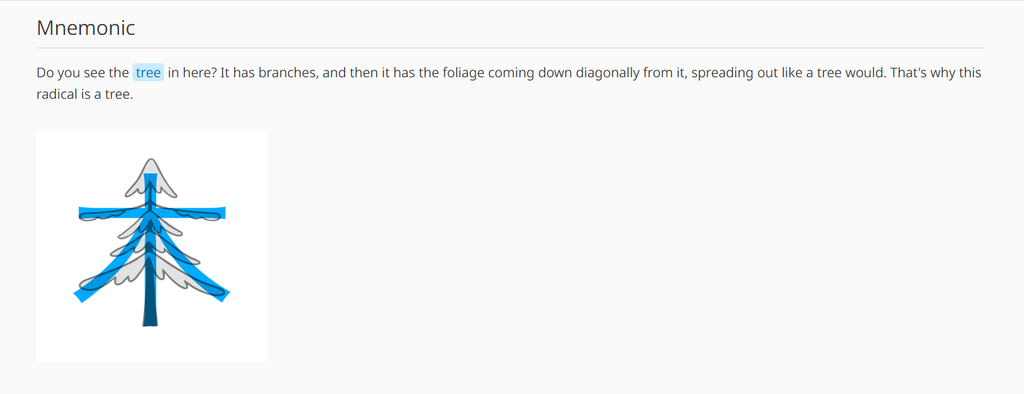
Alt: WaniKani mnemonic example showing a tree illustration to help learners remember a Japanese kanji radical
For example, the kanji 木 (き, ki), meaning “tree,” resembles a tree. Associating the character with this image makes it much easier to recognize. WaniKani uses this technique to teach over 2,000 kanji, and has helped many learners get the hang of not just being able to read, but ‘know’ and ‘feel’ the meaning of the kanji, giving learners a deeper understanding of Japanese kanji and helping them recognize them more confidently when reading Japanese.
Like Anki, WaniKani uses an SRS system to schedule reviews based on your progress, which helps you focus more on characters you struggle with than those you’re more familiar with.
Who Should Use WaniKani?
WaniKani is especially useful for beginners and intermediate learners who struggle with kanji memorization, those building a foundation in reading kanji, and those who prefer a structured kanji study plan.
WaniKani can also be useful as a supplementary tool for JLPT students who want to strengthen their kanji recognition skills to pass the test. However, WaniKani does not directly follow the standard JLPT N5-N1 curriculum. So if you want more structured JLPT prep, I recommend other apps like J-Standard.
4. Renshuu: Best for All-in-One Japanese Learning
Pros of Renshuu:
- Combines vocabulary, kanji, grammar, and listening
- Uses SRS for long-term memorization
- Textbook-based study schedules
- Interactive games with achievements
- Customizable study materials
Cons of Renshuu:
- Some may find large amounts of features overwhelming
- Interface might take time to get used to
- Some features require Renshuu Pro
- Not ideal for learners who want simple flashcards
Renshuu Pricing
| Plan | Price | Features |
| Free | $0 | Vocabulary, kanji, grammar, and core study activities |
| Renshuu Pro Monthly | Paid subscription | Additional study features |
| Renshuu Pro Annual | Paid subscription | Pro features with annual billing |
| Renshuu Pro Lifetime | One-time purchase | Lifetime access to Pro features |
Note: Visit Renshuu’s official website for current prices, regional differences, and available promotions.
Renshuu is an all-in-one Japanese learning app that combines vocabulary, grammar, kanji, and listening into a single platform. Renshuu also uses an SRS system to help learners retain Japanese vocabulary over time. Renshuu also offers games and interactive quizzes to boost engagement. This is a huge con if you find apps such as Anki tedious and want something to enhance your experience. The app also offers personalized study schedules that help learners build a structured routine.
Why Choose Renshuu?
One thing that makes Renshuu stand out is its variety of Japanese learning activities. Rather than constantly flipping through flashcards, learners can practice through different forms such as multiple-choice questions, listening quizzes, typing exercises, sentence-building activities, and even flashcard games
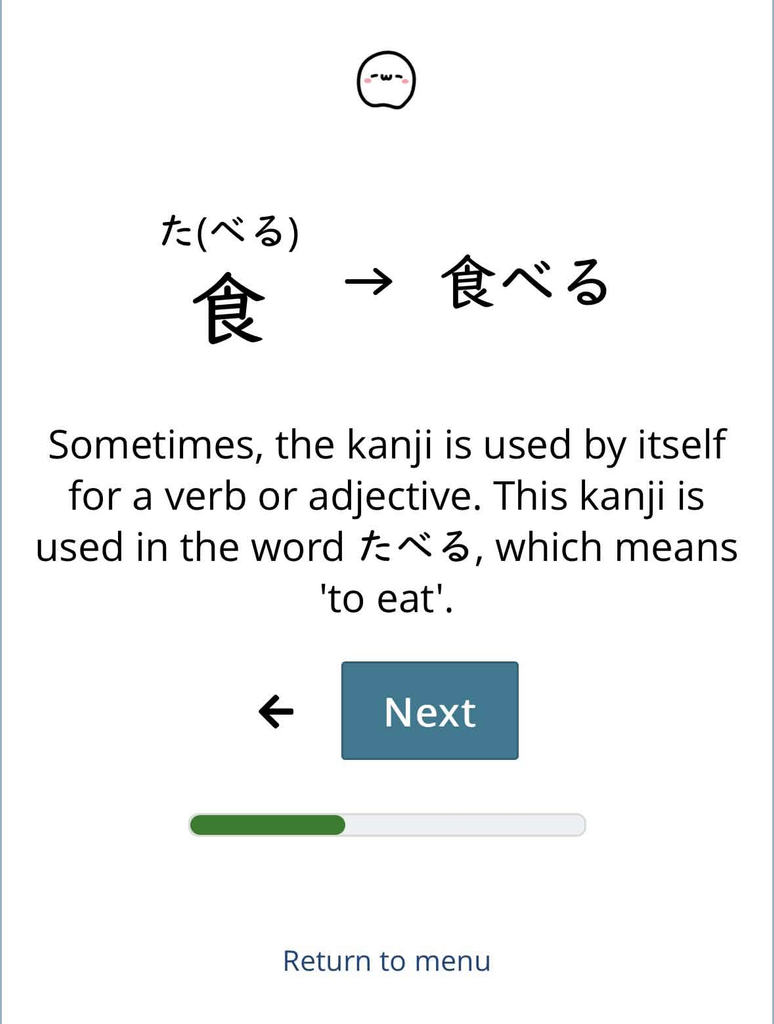
For example, if you learn the Japanese word 食べる (taberu, meaning “to eat”), the app not only shows you the word and its meaning; it also helps you reinforce your understanding with example sentences.
Who Should Use Renshuu?
Renshuu’s ideal user is someone who wants to study vocabulary, kanji, grammar, and listening, all in one place, whether you’re a beginner, intermediate, or advanced. Renshuu is especially useful for those who find flashcard apps like Anki tedious and repetitive and want to do more than just memorize vocabulary. Other people who may find it useful want to build a structured study routine, especially if you’re studying for the JLPT.
5. Quizlet: Best for Simple Japanese Vocabulary Flashcards

Pros of Quizlet
- Beginner-friendly interface
- Customizable flashcards
- Community-created study sets
- Interactive learning modes
- Audio playback for pronunciation
- Easy to share decks with other learners
Cons of Quizlet
- Not specifically designed for learning Japanese
- Community-created flashcards may contain mistakes
- Limited access without paid subscription
- Spaced repetition system (SRS) not as efficient as other apps like Anki
- Doesn’t provide structured learning
- May rely solely on memorization
Quizlet Pricing
| Plan | Price (USD) | Features |
| Free | $0 | Basic flashcards, study sets, and selected activities |
| Quizlet Plus | $35.99/year | Ad-free studying, 20 Learn rounds per month, additional study tools |
| Quizlet Plus Unlimited | $44.99/year | Unlimited Learn rounds, expanded practice tests, and ad-free studying |
Note: Prices reflect Quizlet’s advertised US annual plans and may vary depending on your region and billing method.
Quizlet is one of the most popular flashcard apps for Japanese learners that prefer a simple way to memorize Japanese vocabulary and kanji. Quizlet has been in business for more than 20 years, and, like Anki, it lets users create and review flashcards for not only Japanese but almost any subject you can think of.
Quizlet’s interface is very user-friendly and includes community-created sets, so anyone studying the same thing as you can find your set and use it too. You can also customize your learning modes. If you want to learn flashcard-style, you can choose flashcard. If you want to learn by matching words to their meaning, you can switch to match mode. Quizlet is a popular option for learners who want to start studying vocabulary in different ways without complicated setup.
Who Should Use Quizlet?
Quizlet is ideal for beginner and intermediate-level Japanese learners who want a flashcard app that’s easy to use and not too complicated. It’s also useful for students who prefer short study sessions and want something to share easily with classmates or other learners. Many people who learn for fun use Quizlet for this very reason.
6. Bunpro: Best for Japanese Grammar Practice
Pros of Bunpro
- Grammar and vocabulary decks organized by JLPT level
- Spaced repetition for long-term retention
- Sentence-based grammar exercises
- Detailed grammar explanations with example sentences
- Native Japanese audio for grammar examples
- Customizable reviews
- Progress tracking
Cons of Bunpro
- Less focus on studying kanji
- Grammar reviews may be challenging for some learners
- Full SRS functionality requires paid subscription
- Doesn’t replace speaking practice with native speakers
- No video-based explanations
Bunpro Pricing
| Plan | Price (USD) | Features |
| Free | $0 | Limited access to grammar, vocabulary, and reading materials |
| Monthly Premium | $5/month | Full access to SRS reviews, decks, and premium features |
| Lifetime Premium | $150 one-time payment | Lifetime access to premium features |
Note: Bunpro offers a 30-day free Premium trial without requiring a credit card. Prices may vary depending on your region or app store.
Bunpro is another Japanese learning app that focuses on grammar and also uses a spaced repetition system (SRS) to help learners learn Japanese grammar patterns and how to apply them. The name “Bunpro” is a portmanteau of the Japanese word bunpo (文法), meaning “grammar,” and the English word “pro,” which reflects its focus on helping learners master Japanese grammar.
Unlike most Japanese flashcard apps, Bunpo emphasizes grammar and some vocabulary, from levels N5 to N1. It has an easy-to-use interface and teaches learners how grammar works in sentences through detailed explanations, then has you practice using them in interactive exercises.
Why Choose Bunpro to Study Japanese
What makes Bunpro stand out is its sentence-based grammar reviews. Rather than rmemmemorizingnings lea,rners cracpracticeh grammar point by completing sentences with the acorcorrect Japaneseressions, with wrong answers repeated until tthethey get theg of tacheach patternlt: Bunpro Japanese grammar app explaining the JLPT N4 grammar point for ‘でも’ with examples and sentence structures.
For example, with the JLPT N4 grammar point でも (demo), Bunpo explains how this grammar point can be combined with question words to express meanings such as “誰でも (daredemo, anyone), 何でも (nandemo, anything), and どこでも (dokodemo, anywhere) along with sentence examples and explanations on how native speakers often use this in everyday speech, then tests your understanding by having you practice it yourself. Learners can better understand Japanese grammar points and how they are used in context, rather than through simple memorization.
Who Should Use Bunpro?
Bunpro is ideal for beginner-to-advanced Japanese learners who want to improve their grammar knowledge, comprehension, and sentence-building skills. Those studying for the JLPT at all levels may also find Bunpro useful, as well as intermediate-to-advanced learners who want to deepen their knowledge of Japanese grammar. Advanced learners can also switch the language to Japanese for an immersive approach to studying Japanese grammar in Japanese.
7. Mochi Cards: Best for Customizable Flashcards

Pros of Mochi Cards
- Customizable flashcards with Markdown formatting
- Spaced repetition system (SRS)
- Combines note-taking and flashcard reviews
- Automatic vocabulary card creation with definitions, example sentences, and audio.
- Can import existing Anki Decks
- Unlimited flashcards and decks on the free plan
- Available on desktop and mobile
Cons of Mochi Cards:
- Interface can be complicated for some learners
- Not specifically designed for Japanese learning
- Markdown format may take time to learn (recommended to use AI to make this easier)
- Cross-device synchronization requires a Pro subscription
- Not ideal for those who want prebuilt decks for JLPT study
Mochi Cards Pricing
| Plan | Price (UD) | Features |
| Free | $0 | Unlimited offline flashcard decks, Markdown editing, SRS reviews, and import/export |
| Pro Monthly | Approximately $6/month | Cross-device sync, deck publishing, dynamic fields, and expanded AI features |
| Pro Annual | 60/year(5/month) | Pro features with annual billing |
Note: Prices are based on Mochi’s published plans and may vary by region or billing method.
Mochi Cards is both a flashcard app and a note-taking app that helps Japanese learners learn vocabulary, kanji, and grammar using a spaced repetition system (SRS). Just like Anki, learners can create personalized Japanese flashcards and include images, native audio, and example sentences in each deck. However, Mochi’s Markdown editor makes it even more customizable, making it a strong alternative to Anki for many learners.
Like Anki, Mochi uses a spaced repetition system (SRS), which reinforces learning by having you spend more time reviewing cards you find harder while gradually reducing reviews of cards you already find easy. If you’re a user of Anki, you can even import your Anki decks into Mochi Cards, which makes it convenient for those who want to switch flashcard apps to use existing flashcards, making it a good Anki alternative for those who want a fully customizable study routine.
Why Choose Mochi Cards to Study Japanese?
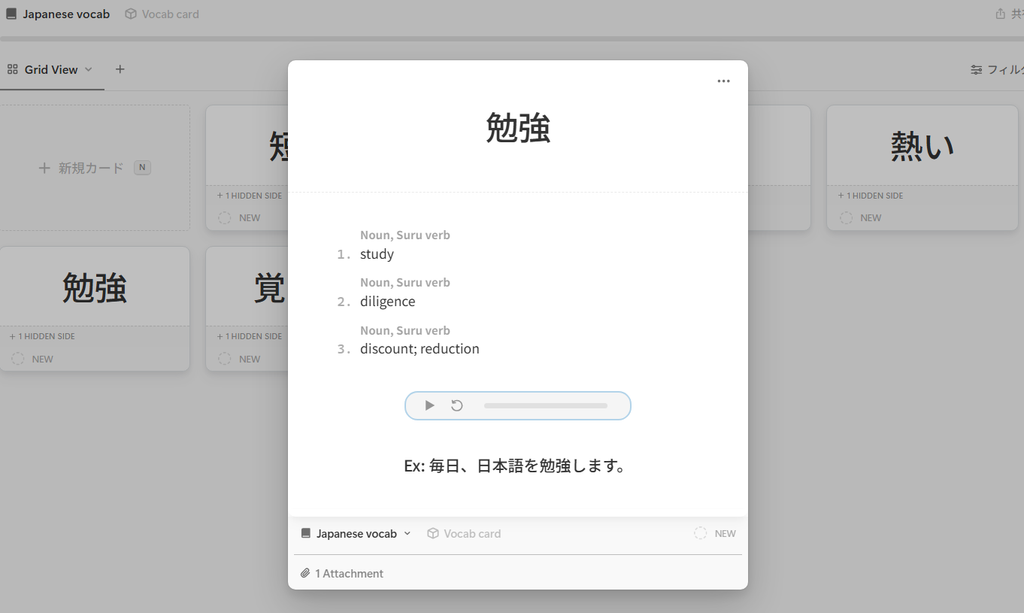
Unlike Anki, Mochi places a stronger emphasis on combining flashcards with organized study notes through a Markdown-based editor, a formatting language that lets learners structure text with headings, bullet points, links, and images without complicated editing tools. This makes it easier for learners to create detailed flashcards with readings, definitions, and example sentences. For example, if you’re studying the Japanese word 勉強 (benkyou, meaning “study”), you can create a flashcard that includes its meaning, reading, audio, and an example sentence such as 毎日日本語を勉強しています (Mainichi Nihongo o Benkyou Shite imasu, I study Japanese every day).
What makes Mochi Cards stand out even more is its ability to connect related flashcards and study notes, letting you organize learned vocabulary and grammar points together rather than studying everything separately.
Mochi also has an automatic function where you can type a word you learned, and it automatically provides the definition, example sentence, and audio without you having to type everything manually, making it more convenient than other apps like Anki.
Who Should Use Mochi Cards?
Mochi Cards is ideal for intermediate and advanced Japanese learners who prefer to create their own flashcards for vocabulary, kanji, and grammar and combine them with their study notes. Because you can connect related study notes and flashcards, your study becomes more organized, and learners may find this feature convenient without having to learn everything separately.
Learners who like to collect vocabulary from anime, manga, and books may find this app especially useful, as the automatic feature can give you everything you need to know about a word by simply typing it in, and Mochi easily turns those words into study materials.
8. Jpdb: Best for Learning Vocabulary from Anime

Pros of jpdb
- Prebuilt Japanese vocabulary decks based on anime, novels, and other media
- Spaced repetition system (SRS)
- Organized list of vocabulary based on anime episodes
- Statistics on word frequency and difficulty
- Learners can easily track down unfamiliar vocabulary
- Reduces the need to create flashcards from immersion manually
- Helps learners prepare for Japanese immersion
Cons of jpdb
- Less suitable for learners who prefer a structured curriculum
- Can be overwhelming for absolute beginners
- Primarily focuses on vocabulary and kanji, but nothing on grammar
- Vocabulary found in media may include uncommon (or even unused) words or expressions
- Web-based interface may be inconvenient for learners who prefer a mobile app
Jpdb Pricing
The features used on jpdb are completely free. However, users can optionally support the platform through Patreon starting at $5 a month. Supporters generally receive a few additional benefits, since their contributions can help cover server maintenance and future development costs.
Jpdb is a Japanese learning platform that helps learners memorize words and kanji from anime, light novels, visual novels, and almost any Japanese media you can think of. Unlike flashcard apps like Anki, jpdb offers prebuilt decks based on specific titles from the chosen Japanese media, so learners can study words they’ll likely encounter while immersing themselves in Japanese content.
Unlike most apps, jpdb is more of a web app; however, it works on mobile, anytime, in any browser, and on the go, so it feels no different from a standard mobile app. The platform also uses a spaced repetition system (SRS). Combined with immersion, this can make learning Japanese more meaningful than simple flashcards.
Why Choose jpdb to Study Japanese?
What makes jpdb stand out is its extensive collection of vocabulary decks from different types of Japanese media, such as anime, manga, and light novels. You might have heard of people creating flashcards from watching anime. Still, with jpdb, learners can search for any Japanese media that interests them and study the vocabulary used in it before they feel ready to immerse themselves, without having to mine sentences.
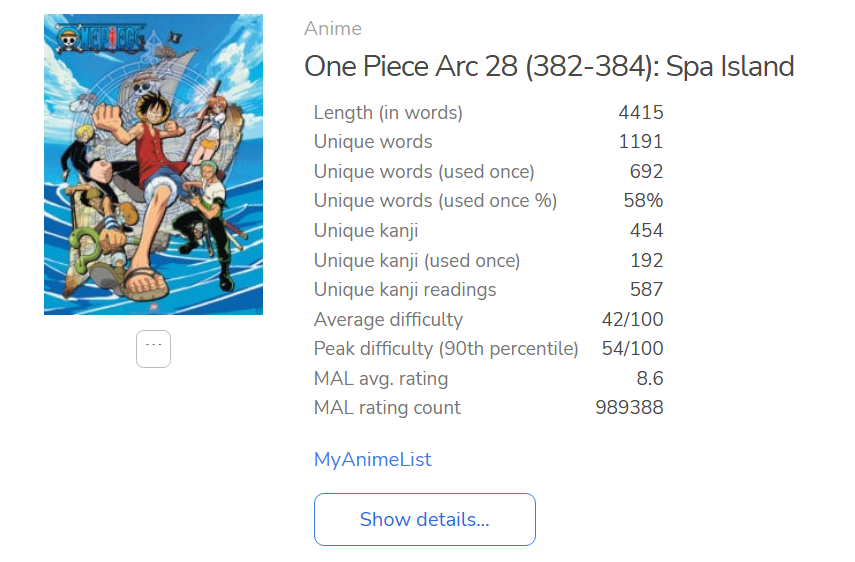
For example, if you’re planning to watch the anime Demon Slayer, jpdb provides an entire list of vocabulary with over 4,000 unique words used in the series. You can review these words in advance and then watch the series, which improves your comprehension without having to pause and look up an unknown word.
jpdb can also show you the most frequent words in a given anime or media, along with a difficulty analysis. This helps learners choose an anime, manga, or light novel that matches their current proficiency level, so they can catch low-hanging fruit and keep learning Japanese engaging and fun.
Who Should Use jpdb?
jpdb is ideal for intermediate Japanese learners who have already built a foundation in the language and enjoy watching anime, reading manga and light novels, playing visual novels, or anything related to Japanese media.
It is also great for learners who don’t like learning from textbooks or textbook-style platforms and want to build vocabulary by watching media they find engaging.
Beginners can use jpdb as well, though many may find immersion in Japanese media difficult to keep up with, which can reduce engagement. Learners at this stage may benefit from learning basic Japanese vocabulary, grammar, and sentence structures before relying on Japanese media as part of their learning routine.
9. Okiru: Best For Building Consistent Study Habits

Pros of Okiru
- Unique alarm-based flashcard system that can encourage regular study
- Spaced repetition system (SRS)
- Built-in JLPT N5-N1 vocabulary
- Daily study streaks and progress tracking
- Rewards you with more decorative themes for each card
- Offline vocabulary reviews
- Can also be used for flashcard practice without setting any alarms
Cons of Okiru
- Currently no free version (requires a payment plan to use)
- Alarm-based studying may not appeal to everyone
- Primarily focuses on vocabulary rather than grammar
- Does not contain audio for those who are auditory learners
- Less customizable features compared to Anki
- Used more as a supplementary tool, and does not replace actual practice
- Currently available on the Apple Store, with no Android version released at the moment
| Plan | Price | Features |
| Okiru Pro Monthly | $4.99/month | Paid subscription with additional Pro features |
| Okiru Pro Yearly | $39.99/year | Annual Pro subscription |
Note: Prices are based on the developer’s published US-dollar subscription rates and may vary depending on your country or App Store region.
Okiru is a Japanese flashcard app that combines a Japanese vocabulary learning app with an alarm clock, helping learners build consistent study habits. The name comes from the Japanese word 起きる (Okiru, to wake up), and as the name suggests, it primarily encourages you to wake up and practice Japanese vocabulary as part of your daily routine.
My colleague Langston Hill, author of The Japanese Language Manual, designed and launched Okiru. It is a relatively new app and has been growing steadily, so it hasn’t announced any new features yet.
Why Choose Okiru to Study Japanese?
What makes Okiru stand out is its built-in alarm clock system. Based on my 10+ years of experience studying Japanese, many learners, myself included, struggle to stay motivated and study consistently, and Okiru lets you set alarms to prompt vocabulary reviews, whether you’re studying for the JLPT or building your own deck.
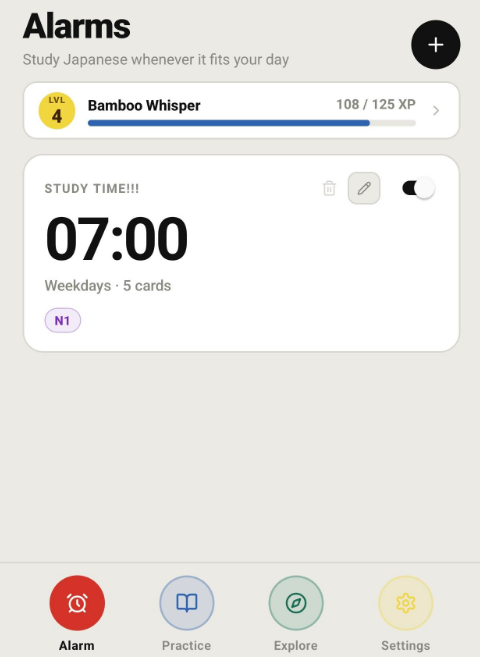
For example, you’re a Japanese learner studying for the JLPT N3, and your exam is a few months away. You promised yourself to study the N3 deck every morning at 7:00 AM, but sometimes you forget. When the alarm goes off, Okiru alerts you that it is study time, and the only way to stop it is to complete your study session, which can motivate learners who often procrastinate. You can even set more alarms to increase your daily study routine, and you can set them for any time that fits your schedule.
Another cool thing about this app, beyond its alarm feature, is that it has similar features to other apps like Anki, such as a spaced repetition system (SRS) and customizable cards and decks. It also includes features Anki doesn’t, such as tracking daily study streaks and vocabulary mastery, which helps users track progress over time.
Although Okiru is relatively new, its developers are still actively adding features, such as unlockable flashcard themes that reward users with experience points.
Who Should Use Okiru?
Okiru is ideal for Japanese learners who struggle with procrastination, consistency, or frequently forget to review their flashcards. Sometimes, no matter how good a flashcard app is, or how good your study methods are, some learners can be forgetful or tell themselves they’ll just do it later. This is where Okiru helps these learners.
Others who may find Okiru useful include students and busy working professionals who want to incorporate Japanese flashcards into their morning routines, study breaks, or daily schedules to keep them busy during their free time.
Learners preparing for the JLPT and looking to take their study habits more seriously may also find this app useful as a supplementary review tool for their upcoming exam, as it includes built-in JLPT vocabulary decks for every level.
10. Kitsun: Best For Ready-Made Vocabulary Decks

Pros of Kitsun
- Prebuilt Japanese vocabulary and kanji decks
- Community-created study materials
- Spaced repetition system (SRS)
- Automatic dictionary-based flashcard generation
- Customizable flashcard layouts
- Community feedback for each deck
- Supports other subjects beyond Japanese
Cons of Kitsun
- Requires a paid subscription for continued full access
- Unavailable for Apple users
- Some community decks may contain errors or outdated information
- Doesn’t replace grammar, listening, or conversation practice
- Less attractive for learners who prefer completely free flashcard apps
Kitsun Pricing
| Plan | Price (USD) | Features |
| Monthly | $8/month | Access to community decks, SRS reviews, and flashcard creation tools. |
| Yearly | $64.99/year | Full access with discounted annual billing |
| Lifetime | $199 one-time payment | Lifetime access to all learning features |
Note: These prices come from Kitsun’s published pricing documentation. Confirm the current checkout prices before subscribing, as the documentation may not reflect recent changes.
Kitsun is a flashcard platform that helps Japanese learners build vocabulary and kanji through a spaced repetition system (SRS). The name Kitsun comes from the Japanese word 狐 (Kitsune), which means fox, hence the brand logo. With Kitsun, learners have a large collection of ready-made community decks, so they can start studying right away without building vocabulary lists from scratch. Kitsun also offers flashcard decks for other languages and subjects beyond Japanese. It also offers Japanese-specific tools, such as dictionary-based flashcard creation, making it a useful option for learners who want to expand their Japanese vocabulary.
Why Choose Kitsun to Study Japanese?
What makes Kitsun stand out is its collection of community-created vocabulary decks. Instead of manually entering hundreds of Japanese words, learners can browse pre-made decks and choose the one that best fits their study goals.
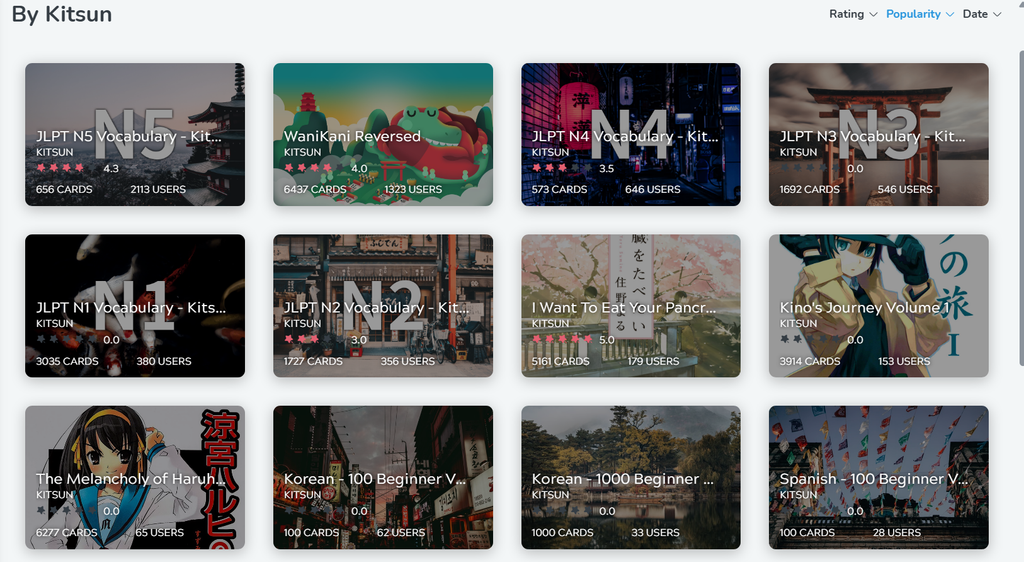
For example, Kitsun offers community decks for JLPT levels N5 through N1, which helps JLPT students find the right deck. It also offers decks based on popular anime, such as The Melancholy of Haruhi Suzumiya. Each deck shows its vocabulary card count, user count, and community ratings, similar to jpdb, making it easier for learners to prepare to immerse themselves in their favorite anime without manually sentence-mining every episode.
Kitsun also has a spaced repetition system (SRS), like many flashcard apps. Its custom flashcard mode also has useful tools for creating flashcards from Japanese dictionary entries. For example, if you are reading a book and encounter a word you don’t know, you can look it up in Kitsun, and it automatically generates a flashcard without you having to enter all the information manually, as in Anki.
Kitsun also includes community feedback, allowing users to suggest corrections or improvements to shared decks.
Who Should Use Kitsun?
Kitsun is ideal for Japanese learners of all levels who want to study vocabulary using prebuilt decks rather than spending time manually creating their own, but are also open to creating their own decks.
It’s also useful, particularly for learners who follow other resources such as WaniKani, with its WaniKani-based decks. Learners who want to supplement their Japanese with additional vocabulary practice may also find it useful.
How to Choose the Best Japanese Flashcard App for Your Learning Goals

Every learner is different, so not every flashcard app is right for everyone. If you’re not into anime or manga, jpdb might not be the best choice for you. If you want more structured learning, Anki and Mochi Cards might feel too tedious. With this in mind, consider your learning goals to determine which app best fits them.
Best for Beginners and Intermediate Learners (JLPT N5-N3)
If you’re studying for the JLPT N5, N4, or N3, I recommend starting with a more structured app that offers a vocabulary list. Creating your own deck can take a lot of time and energy, so it is best to focus on decks with vocabulary that will likely show up on the JLPT level you plan to take
Renshuu and Kitsun are great options for this, because they offer JLPT-related vocabulary materials organized by JLPT N5-N1 difficulty.
If you’re seriously preparing for an upcoming JLPT exam, J-Standard could be an ideal choice. It could help you follow a more structured study routine, as the lessons cover vocabulary, grammar, reading, and listening. It includes everything you need to boost your chances of passing the JLPT.
For Upper-Intermediate and Advanced Learners (JLPT N2–N1)
At the N2 and N1 levels, you’ll likely encounter more complex, specialized vocabulary and expressions more often. Words that might pop up in textbooks or even everyday Japanese. At this stage, Anki and Mochi Cards are ideal because they let you create personalized flashcard decks based on what you encounter in your Japanese immersion, such as Japanese articles, novels, and advanced anime (e.g., Death Note). Whatever you’re using to consume Japanese media, these two are often the most common choices.
If you rely solely on anime and manga, jpdb is another great option. It lets you learn specialized vocabulary often used in anime and optionally add it to your own flashcard decks before you’re ready to engage with that content.
For Learners Who Want to Focus on kanji
If kanji is one of your biggest weaknesses in learning Japanese, WaniKani is one of the best options in this list. WaniKani’s use of mnemonics, radicals, and spaced repetition can help learners recognize not only kanji, but also their readings and meanings. The app is quite structured, which makes it easier for those who don’t know where to start to improve their kanji.
Another good option for more advanced learners looking to expand their kanji knowledge is Anki. This app offers more flexibility and lets you add cards beyond what WaniKani provides, whether you’re preparing for the N1 or the kanji Kentei (漢字検定, kanji Aptitude Test).
For Casual Learners and Those Building Study Habits
Not everyone studying Japanese is preparing to take the JLPT. Some learners simply want to learn vocabulary whether it’s for traveling to Japan, watching anime without subtitles, or having everyday conversations with Japanese people. If this applies to you, Quizlet can be a good starting point, as it offers a variety of community-made decks to help you prepare for whatever your goal is in Japanese. This gives you a good chance to learn what you need without making flashcards yourself. Anki also offers community decks, though downloading them can be more of a hassle than on Quizlet.
If you struggle to maintain a consistent study routine, Okiru is an app designed to deal with this, as it offers scheduled alarms and reminders, as well as unlockable awards as you continue studying, such as flashcard themes, which give you an extra reason to continue practicing Japanese. Jpdb can also be a good choice if you want to casually learn by watching anime. One thing to keep in mind: choose the Japanese flashcard app that best fits your learning goals. If you don’t like anime, you don’t have to force yourself to create flashcards from Jpdb. If you find structured study boring and want more freedom, you don’t need to keep using Renshuu just because you heard good reviews.
While I have emphasized that using multiple apps can reinforce learning, if using more than one flashcard app feels overwhelming, one app is more than enough. What matters is what you’re most comfortable with and building a consistent study habit. As long as you find an app that fits you and your goals and can do this, that should be more than enough to meet your flashcard needs!
Flashcards Alone Aren’t Enough to Become Fluent in Japanese
Japanese flashcard apps can be great if your goal is to memorize more vocabulary and kanji and study what you need for the JLPT, and spaced repetition can help you retain what you’ve learned. However, actual fluency in Japanese takes more than knowing a ton of words.
For example, if you learned that the word 食べる (taberu) means “to eat,” you might still struggle with how it’s used grammatically, such as its past-tense form 食べた(tabeta), meaning “to have eaten, or its te-form, 食べて(tabete), which is a way to connect the verb in a sentence. Learning vocabulary solely through flashcard memorization might not be enough to catch these conjugated forms. Many learners can recognize what a word means but struggle to understand the meanings of different conjugation forms.
This is why it’s important to combine vocabulary study with grammar explanations, listening practice, and even practicing with a Japanese native speaker.
Consider Studying with J-Standard

If you’re looking for a more structured way to study alongside your flashcards, J-Standard, developed by Coto Japanese Academy, offers JLPT-focused learning materials that go beyond vocabulary memorization. Japanese teachers with experience and expertise in helping students prepare for the JLPT exam organize J-Standard.
J-Standard offers pre-recorded grammar video lessons, video quizzes, practice tests, and everything you need to prepare for the JLPT. Even if you aren’t preparing for the JLPT, many students may find these structured lessons useful for improving their Japanese. If you want to boost your chances of passing the JLPT, apply at J-Standard Now!
FAQ
Anki is still one of the best Japanese flashcard apps, especially for learners who want customizable decks with spaced repetition (SRS). What makes Anki stand out is its simple, user-friendly interface and its flexibility, which makes it useful for memorizing Japanese vocabulary and kanji at any JLPT level. However, not everyone might like Anki, and may prefer something more structured, such as Renshuu or WaniKani.
Free Japanese flashcard apps can build a strong foundation in Japanese vocabulary. Anki’s desktop and Android versions are completely free, while Renshuu and jpdb offer free study features that can be enough to build that foundation. However, flashcards alone won’t help you master everything. You’ll also need to learn grammar, get more listening practice, read more, practice speaking, and engage with Japanese as much as you can beyond memorizing flashcards.
Free Japanese flashcard apps can build a strong foundation in Japanese vocabulary. Anki’s desktop and Android versions are completely free, while Renshuu and jpdb offer free study features that can be enough to build that foundation. However, flashcards alone won’t help you master everything. You’ll also need to learn grammar, get more listening practice, read more, practice speaking, and engage with Japanese as much as you can beyond memorizing flashcards.
Japanese flashcards are one of the most effective ways to memorize JLPT vocabulary and kanji, especially if they use a spaced repetition system (SRS). Apps like Anki, Renshuu, and Kitsun offer JLPT-related study materials. However, the exam also tests grammar, reading, and writing. For more comprehensive preparation, J-Standard offers structured JLPT lessons, pre-recorded grammar videos, and vocabulary quizzes that are designed to help students pass the JLPT (N5 – N2)