Best JLPT Study Apps for Self-Learners in 2026
If you’re studying for the JLPT, downloading a study app or two can make a real difference. The reality is that not everyone working toward better Japanese has time for regular classes, but a good app fits into the gaps in a busy schedule, whether that’s a commute or a coffee break.
With visa requirements increasingly tied to JLPT scores, many learners feel pressure to improve fast. The test spans five levels, from N5 to N1 (near-native proficiency), and whatever level you’re aiming for, the right app can sharpen your vocab, kanji, grammar, and test-taking speed.
We’ve tried a lot of these apps. Here are the ten we think are actually worth your time.
What Makes an App Good for JLPT Study?
There are hundreds, if not thousands, of Japanese learning apps out there: flashcard apps, gamified ones like Duolingo, grammar-focused apps, you name it. But apps built specifically for JLPT prep are far fewer.
That’s because while JLPT and general Japanese language learning overlap a lot, the JLPT tests a specific curriculum: four sections covering vocabulary (including kanji), grammar, listening, and reading. An app that’s great for casual conversation practice won’t necessarily prepare you for the test itself.
Below, we’ve picked apps built specifically for JLPT prep.
Best JLPT Apps
| App | Kanji | Vocab | Grammar | Listening | Reading |
| J-Standard | ✓ | ✓ | ✓ | ✓ | ✓ |
| Anki | ✓ | ✓ | – | – | – |
| Migii JLPT | ✓ | ✓ | ✓ | – | – |
| Todaii | – | ✓ | ✓ | – | ✓ |
| JLPT Test (N5–N1) | ✓ | ✓ | ✓ | ✓ | ✓ |
| JLPT Encyclopedia | ✓ | ✓ | ✓ | – | ✓ |
| Bunpo | – | – | ✓ | ✓ | – |
| WaniKani | ✓ | ✓ | – | – | – |
| Migaku | – | ✓ | ✓ | ✓ | ✓ |
| Renshuu | ✓ | ✓ | ✓ | – | – |
1. J-Standard
Pros:
- Complete study materials for all JLPT test sections
- Clear progression towards your desired JLPT goal
- Lessons structured by real teachers in Japan
- Includes JLPT-designed assessment
- Includes immersive video lessons for pronunciation & listening skills
Cons:
- Not 100% free (two-week free trial)
Cost: $180/year or $69/month
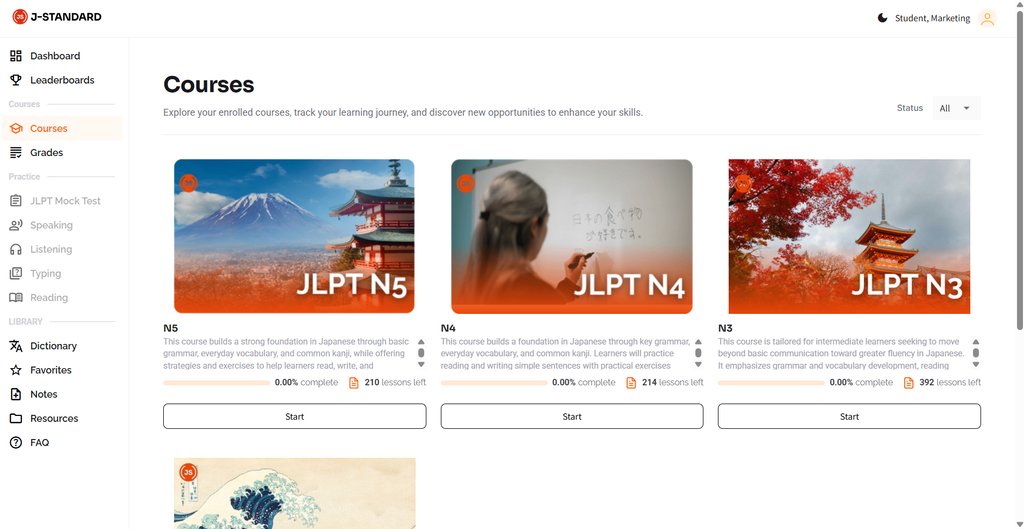
J-Standard is the overall best JLPT app for focused progress toward a specific level.
J-Standard is an e-learning platform that helps learners from JLPT N5 to N1. The standout advantage is that it’s all-in-one: no need to download separate apps for different skills.
The platform helps build grammar, vocabulary, listening, and real-world fluency through guided lessons and practical drills. Each JLPT level currently offers over a hundred lessons with quizzes, tests, and unit exams written by teachers in Japan. Measuring your progress in real time is highly reinforcing, compared with apps that leave you feeling like you are getting nowhere (three months of Duolingo and you can awkwardly request water and a bowl of white rice).
More content is currently being created, specifically aimed at the N2 level, the highest required for any visa.
2. Anki
Pros:
- Great for learning vocabulary
- Simple, straightforward, intuitive interface
- Many niche topics not found elsewhere
- Decks created by users in many languages
- Very efficient for kanji memorization
Cons:
- All content is user-uploaded, so be wary of mistakes
- Offers nothing more than simple flashcards
Cost: Free ($24.99 for Apple App Store)
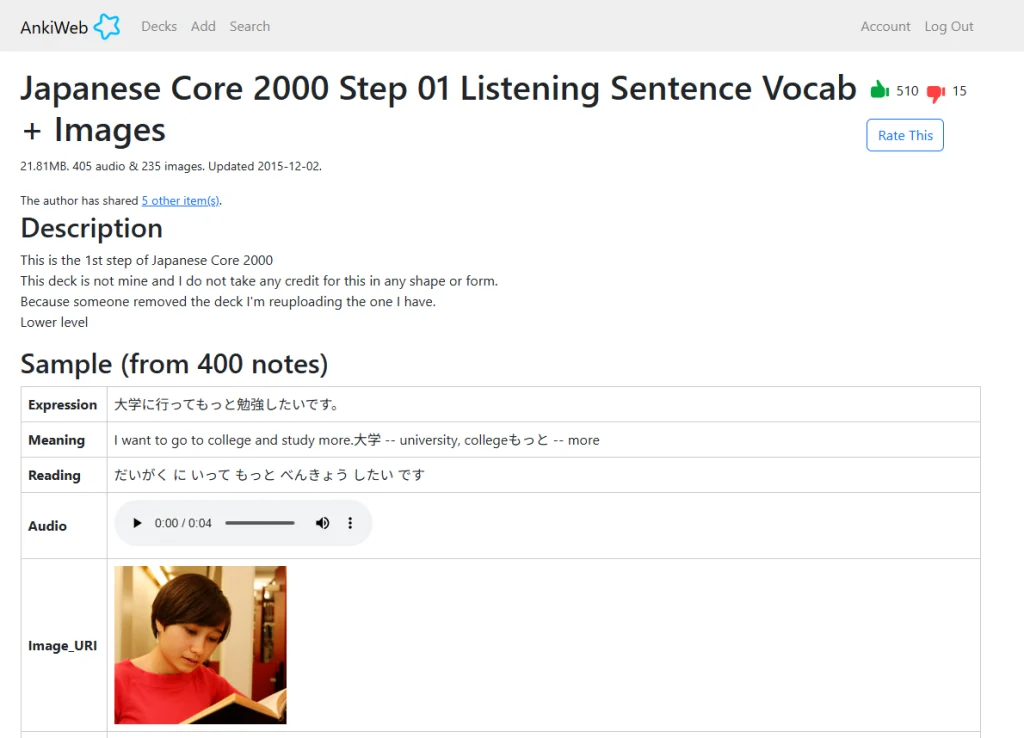
If you are looking to study kanji, look no further. Anki is a very useful application version of traditional flashcards. This repetition is one of the most efficient ways to recognize and memorize your kanji goals. It is an open-source learning platform, so you can choose from thousands of user-uploaded sets, offered in many native languages. Anki isn’t dedicated to Japanese study, but it’s become very popular in the community because of its effectiveness. You can sort your search by whatever theme, vocabulary, JLPT level, or whatever you want to study. The original desktop version is free, along with the Android version (AnkiDroid), however, the IOS app (AnkiMobile) costs ¥4,000 to download.
Check out some recommended Anki decks for Japanese learning.
3: Migii JLPT
Pros:
- JLPT level-specific coursework
- Offers grammar, vocab, kanji, test prep
Cons:
- Lessons and material are basic and shallow
- Vietnamese company, so content isn’t reliable Japanese
Cost: Free version available, $119.99 for a lifetime membership
A similar alternative to our top recommendation is Migii JLPT. It offers a specific JLPT-level-focused structure. The lessons and materials are not very deep, and are mostly flashcards and quiz questions. However, the first lessons and materials for the N5 level are free if you want to get a taste before you commit. They offer JLPT mock tests with a synchronized roadmap to track your progress toward full marks on the test you are aiming for. The app is available on the App Store, Google Play, and also on their website.
4. Todaii
Pros:
- Real news articles
- Grammar lessons
- Dictionary
- Mock JLPT reading tests
Cons:
- Daily limit of three readings for free users
- Lessons are shallow
Cost: Free
One quarter of the JLPT consists of short to long passages that test reading comprehension. Even if you are blessed with the naturally acquired skill of reading Chinese characters, this can be quite intimidating with a clock ticking next to you. The best way to prepare for the reading sections of the test is to actually read.
Todaii is our top recommendation for reading comprehension practice because it offers real news stories with furigana above all the kanji, paired quiz questions, vocabulary in flashcard form, and clear JLPT-level designations for each article. You can sort news articles by JLPT level, and even read some fictional stories if you want a change. It also includes free grammar lessons, a Japanese dictionary resource, and JLPT reading practice quizzes.
5. JLPT Test (N5 – N1)
Pros:
- Great for quick mock tests
- Massive question bank: 40,000+ questions, 1,500 reading items, and 200 past exams
- Test topics cover all major sections
Cons:
- Some users complained about mistakes in kanji and grammar within the test questions
- The app can be glitchy
- Not a teaching app in the traditional sense
Cost: Free
JLPT Test is one of the few apps focused solely on mock tests. It contains tests on kanji, vocabulary, grammar, listening, reading, and a general exam. It improves your Japanese knowledge through repeated exposure, timing, and repetition rather than direct instruction. With such a large pool of questions and past exams, you can spot weak grammar points, slow reading habits, and careless answer patterns fast. However, it’s not a teaching app in the usual sense: it shows you where you fail, then leaves it to you to fix those gaps elsewhere.
6. JLPT Encyclopedia
Pros:
- Strict JLPT question content
- Kanji handwriting feature
- Many free lessons
Cons:
- Many ads, NSFW (or train)
- No access to a real teacher, no way to ask questions
- No interactive or personalized content
Cost: Free
This is a more straightforward app, better suited for those with minimal Japanese experience. All content is broken down into the five JLPT levels, and the material is split into in-depth lessons or JLPT test questions. This app really throws Japanese at you, since the tests and answers are all in Japanese, so you must sink or swim. Questions cover grammar, reading, vocabulary, and kanji. This forced immersion is a great way to force yourself to learn and get used to the language. For kanji study, the app features flashcards and a nice handwriting feature to practice stroke order.
7. Bunpo
Pros:
- Beginner friendly
- Small, well-organized individual lessons
- Audio & video lessons
Cons:
- Many great features locked behind a paywall
- Not clear, focused practice for JLPT levels beyond N4
Cost: Free, up to $49.99 for lifetime payment
This app is great for those who are at the very beginning of their Japanese learning journey. If you have never tried Japanese before, you can start by learning the hiragana and katakana alphabets before progressing further. Lessons are heavily illustration-guided, supporting visual-mental association that improves learning. Focused on beginner learning, there are 4 levels, with JLPT N3-N1 grouped together as “advanced”. Bunpo, meaning grammar, focuses on grammar with in-depth explanations and useful daily applications. A premium version offers tutor access and advanced support features.
8. WaniKani
Pros:
- Uses mnemonic stories to aid memorization
- Structured around 60 levels progressed through linearly
- The first three levels are free
- Well-suited for N3 to N1 learners who want steady, structured kanji progress without starting from scratch
Cons:
- Reviews are timed, with no option to skip kanji or radicals you already know
- Uses a unique radicals system, which can cause confusion if you’re used to traditional radicals
- Kanji-and-vocabulary only — no grammar or listening practice
Cost: $9/month, or $299 for lifetime
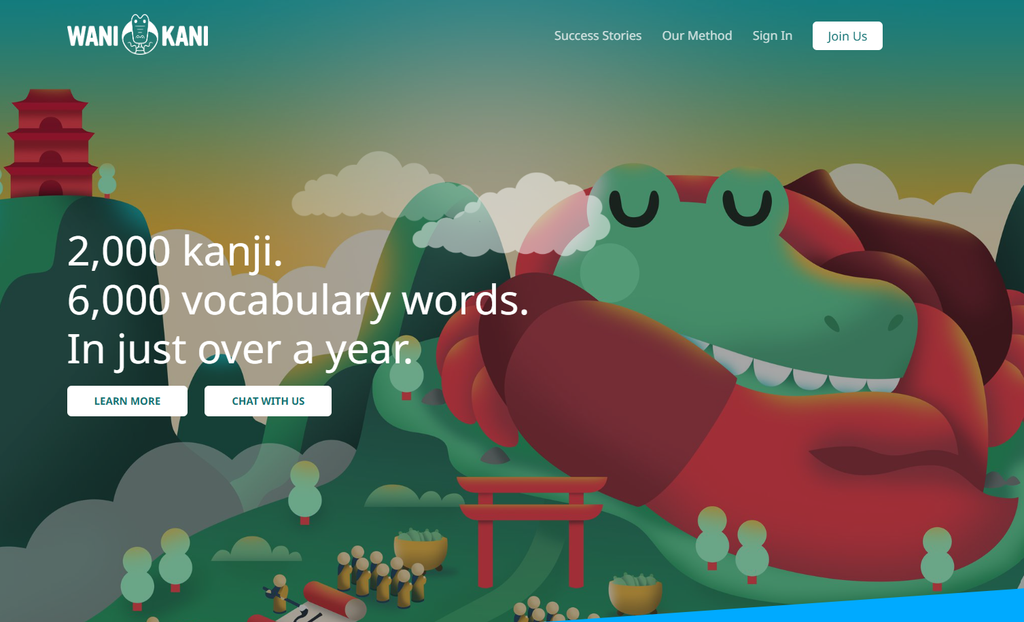
WaniKani’s radical-kanji-vocabulary progression is what sets it apart from generic flashcard apps. By teaching the building blocks of a character before the character itself, it helps meanings and readings stick together rather than being memorized as isolated facts. That structure makes it especially strong for N3–N1 learners who want steady, low-effort kanji reinforcement. The trade-off is flexibility: the linear, level-gated path means you can’t jump ahead or customize pacing, and since it only covers kanji and vocabulary, learners still need a separate tool (like J-Standard or Anki) for grammar and listening.
9. Renshuu
Pros:
- All-in-one: vocabulary, kanji, grammar, and JLPT-specific study paths in one place
- Deep content library, including thousands of kanji, vocabulary audio clips, and example sentences
- Highly personalized
- Free version is genuinely unlimited, no paywall timer
Cons:
- Customization can feel like a lot to configure at first
- Full depth and premium features require a subscription or one-time purchase
- Less structured than kanji-only apps like WaniKani
Renshuu positions itself as an all-in-one alternative to stitching together separate apps for vocabulary, kanji, and grammar, closer in scope to J-Standard than to a kanji-only tool like WaniKani. Its standout strength is personalization: learners can follow structured JLPT or textbook-aligned paths, or build their own from a large user-generated library, and the difficulty adapts down to the individual kanji or word level. The trade-off is that this flexibility asks more of the learner to configure and direct their own study, whereas apps like WaniKani hand you a fixed sequence.
Tip: Don’t Download Too Many Apps
Though we’ve recommended 10 JLPT study apps, we don’t necessarily recommend downloading all of them. What we recommend instead is keeping it simple — for example, one main app for vocab and kanji, and another for grammar. It’s easy to end up mixing too many mediums at once: textbooks, apps, flashcards, and everything else, all competing for your attention.
Consistency matters far more than chasing the “best” app. Some apps look polished but don’t actually reflect real JLPT question style, so working practice tests into your routine is essential, not optional.
For grammar, for example, you can rely on Bunpo, since it’s structured cleanly by JLPT level and lets you progress day by day. For vocabulary, you can build your own deck on Anki.
Conclusion
There are an overwhelming number of options for how to study for your JLPT exam. Apps are a great way to study for a busy, yet dedicated individual like yourself. Whatever you need to focus on, there is a dedicated app for it.
If juggling separate apps for each skill sounds like more hassle than it’s worth, that’s exactly the gap J-Standard is built to close: grammar, vocabulary, listening, and reading all in one place, so you’re not stitching together three different tools and hoping they stay in sync.
Sign up and get a 14-day free trial!
FAQ
Yes, easily with some dedication. The N5 exam covers 100 kanji, 800 vocab, and 80 grammar points. This would require 1 – 2 hours of daily study over 3 months.
Depends. Your quality of life independently will be poor. Basic, predictable daily functions like buying groceries or asking for directions will be manageable. Mandatory bureaucratic tasks like ward office registration will be completely impossible.
Yes, you can. You can take and retake the exams as many times as necessary. The exams are offered in July and December in Japan.